Walmart is building a door for outside shopping agents. Amazon is expanding the catalog inside its own. For sellers, those moves create different routes to the same customer.
Walmart’s announced Agent Gateway starts as a developer beta. Amazon, which blocked Meta’s Muse according to an Amazon statement reported by Axios, now offers Shop Direct catalog intake for eligible outside merchants.
For sellers evaluating AI shopping agents, calling one company “open” and the other “closed” misses the decision: where can your products appear, where does the purchase happen, and what can you measure afterward?
The short version
- Access and checkout are separate choices. An open commerce protocol does not guarantee admission to an AI channel.
- Checkout location matters. ChatGPT’s default path sends buyers to your site; Google offers checkout on its surfaces while you remain seller of record.
- Start with the channels your stack already supports. Eligible Shopify stores can have Copilot direct checkout active by default. Audit settings and measurement before commissioning another integration.
US-focused. Last verified: November 9, 2026 (Europe/Warsaw). Recommendations are editorial judgments, not forecasts.
What are open and closed AI shopping agents?
Assess retail-agent openness on two independent axes: can outside agents enter the retailer, and can outside merchants enter the agent’s sales channel? Evaluate checkout, customer data and reporting separately for each route.
At a glance
- AI shopping agent: our working term for an assistant that discovers products or acts on a shopper’s behalf; discovery does not imply autonomous checkout. Compare OpenAI’s discovery path.
- Retailer access: permission for outside agents to shop a destination.
- Merchant intake: eligibility to distribute your catalog through an assistant.
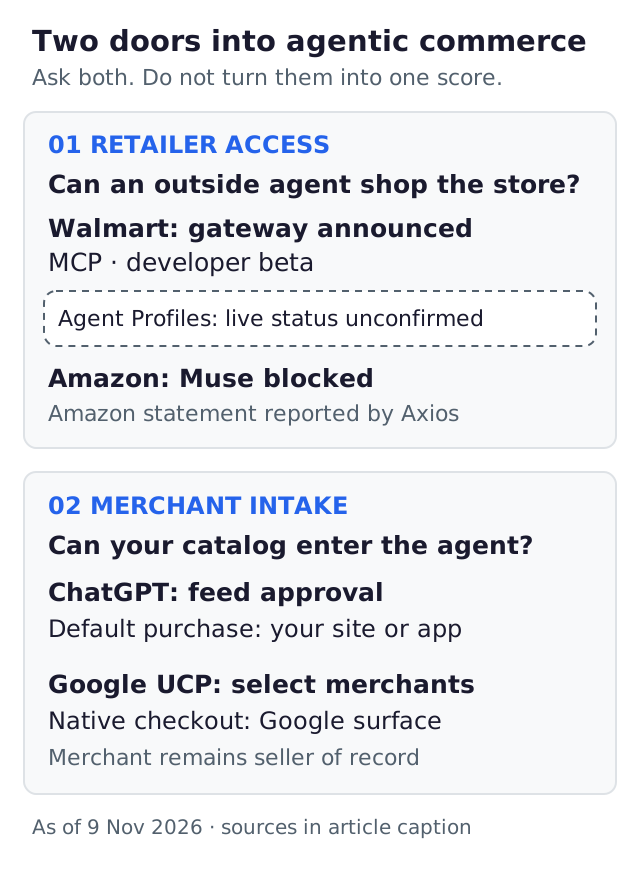
Access map, not a market-share chart. Sources: Walmart’s announcement, Amazon’s statement via Axios, ChatGPT merchant intake, Google checkout eligibility.
For each channel, check admission rules, product eligibility, checkout ownership, buyer data and reporting. “Merchant of record” describes the transaction role; don’t assume it guarantees marketing consent, complete customer data or attribution.
In Shopify’s formulation, “UCP is the passport, but every platform still issues its own visa.” UCP means Universal Commerce Protocol; ACP means Agentic Commerce Protocol. They describe how systems exchange commerce information, not a right to distribution.
AI shopping agents compared: access, checkout and reporting
Scroll the tables horizontally on narrow screens. These are documented paths, not an exhaustive integration directory. “Unknown” means not established by the sources reviewed, not that a feature cannot exist.
| Channel | Entry route | Where checkout happens |
|---|---|---|
| Walmart | Announced MCP gateway, developer beta; Marketplace offer coverage unknown | Walmart account; approval by default |
| Amazon / Alexa | Shop Direct: eligible outside merchants submit feeds; Muse blocked | Merchant site: buyer clicks through, or Buy for Me purchases there |
| ChatGPT | Feed application; Shopify/Etsy catalogs integrated | Merchant site or app by default |
| Google AI Mode / Gemini | Select merchants, phased UCP onboarding | Google native checkout or cart transfer; seller remains seller of record |
| Shopify channel hub | Catalog distributes to multiple agents | Shopify-powered direct checkout or merchant redirect, depending on channel settings |
| Meta Muse | Browser access, Shopify Catalog, or approved connector | Shopify checkout, browser purchase or connector transaction |
| Microsoft Copilot | Eligible Shopify stores via Catalog; other routes not assessed | Shopify direct checkout in chat or merchant redirect |
Reporting and protocol details by channel
| Channel | Documented integration | Documented merchant reporting |
|---|---|---|
| Walmart | Announced MCP gateway | Unknown |
| Amazon Shop Direct | Feed providers or Selling Partner API | Workspace shows active products; not evidence of sales performance |
| ChatGPT | ACP product feed; approved onboarding over SFTP | Unknown |
| UCP integration through Merchant Center | Unknown for native checkout in the reviewed documentation | |
| Shopify / Meta | Catalog and Shopify checkout | Meta-attributed orders and channel performance in admin |
| Muse connector | API or MCP documentation and Meta review | Unknown beyond the Shopify route above |
| Copilot / Shopify | Shopify-powered checkout | Server-to-server checkout events; no GA or custom client-side pixels |
Walmart Agent Gateway vs. Amazon Shop Direct
Walmart’s opening comes with account controls
Walmart’s announcement describes an MCP gateway and Agent Profiles. Profiles were announced as launching within a month; live availability is not confirmed. Purchase approval is the default. The $50/$100/$200 figures are customer-set examples, not fixed tiers or session caps. Agents do not receive card details or permission to change payment methods.
Marketplace offer coverage remains unresolved. Don’t forecast gateway orders for your listings until that scope is documented.
Amazon Shop Direct brings buyers to outside stores
Eligible merchants can verify their websites and submit catalogs through feed providers or the Selling Partner API. Merchants choose selection and can opt out. Workspace shows active products; it is not a sales-performance report.
Amazon’s documented Muse restriction coexists with this merchant intake. Evaluate profitable orders from Amazon-generated demand, not whether Amazon deserves an “open” label. The FAQ explains the separate Buy for Me purchase path.
Sell on ChatGPT or Google UCP: checkout trade-offs
ChatGPT defaults to merchant-owned checkout
OpenAI is prioritizing discovery and merchant-owned checkout. Its merchant page says purchases on merchant sites or apps carry no OpenAI purchase fees; this does not mean zero payment-processing cost. For a reliable storefront, start by assessing a feed project, not rebuilding checkout. Eligibility and onboarding are covered below.
Google can host checkout while you remain the seller
Google UCP checkout supports eligible purchases in AI Mode or Gemini through Google Pay while you remain seller of record. The integration hub supports cart transfer and identity linking, with gradual US onboarding. Ask your platform what it already supports before implementing endpoints.
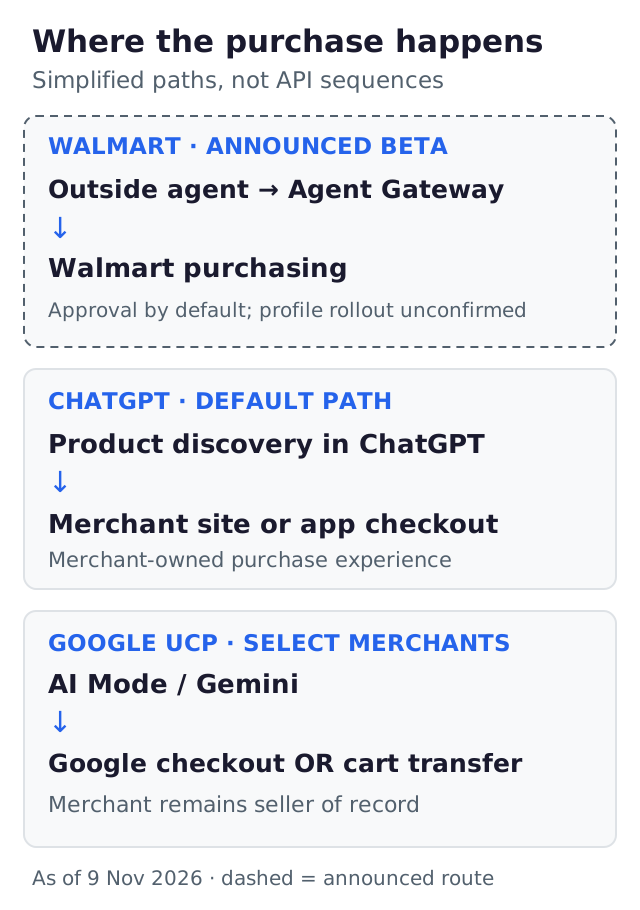
Simplified paths, not API sequences. Walmart is not verified as generally available. Sources: Walmart, OpenAI, Google.
Shopify agentic storefronts: audit each channel
Shopify’s Fall ’26 release adds Catalog eligibility checks and a Knowledge base for approved merchant facts. Shop Pay uses card-network tokens for supported off-Shopify purchases—not the one-time cards Meta describes for Stripe Link.
Meta direct checkout and Copilot direct checkout can be on by default for eligible stores. Copilot’s documentation lists unsupported subscriptions, bundles, customizable products and local pickup; its client-side pixel limitation is explained in the FAQ. Don’t generalize those rules to every agent.
Muse also browses ordinary websites. Approved connectors are an optional structured route, not a requirement for every non-Shopify seller.
How to measure AI referrals and agent orders
Enalitica’s analysis of 100,000+ orders reports AI referrals near 1% of orders at its median customer store, with ChatGPT contributing about 95% of AI-referred orders. It calls the estimates a floor because referral data can be lost. Enalitica sells attribution software; this is its customer sample, not a market census.
Those are referral-attributed orders, not a count of autonomous purchases. Use them as a reason to inspect your own orders, not as a forecast of agent checkout demand.
Access tests need the same care. Human Forward’s crawler was refused by 86 of 200 US sites, and another 12 did not load. It explicitly says this does not prove a named assistant is blocked. Human Forward sells an agent storefront product.
Which AI shopping channel should you prepare first?
Marketplace-only seller: prioritize the listings you already control. For Walmart, verify gateway offer coverage before funding a separate integration; that scope is still unknown in the announcement.
Shopify brand: inspect existing Agentic settings and Catalog eligibility first. ChatGPT is a discovery/referral channel; Copilot can use direct checkout. Test the resulting order and events before adding another build.
Large-catalog retailer with its own checkout: shortlist ChatGPT feed intake and Amazon Shop Direct; assess Google UCP through your platform. Choose one operationally manageable catalog slice, not every SKU at once.
This is an effort-and-control decision guide, not a revenue ranking.
What to do this quarter
This is a preparation order, not a claim that one channel will outperform another. Move an existing low-effort integration ahead of a speculative custom build.
- Baseline access and orders. Review bot-protection errors and known AI referrers. Cloudflare now documents per-agent traffic views and policies. Keep browse, login and purchase permissions separate; don’t blanket-allow automation.
- Create a channel-ready catalog slice. Start with products you can fulfill reliably. Check variant IDs, price, stock, dimensions, compatibility and return terms. Keep a canonical catalog with channel-specific mappings; “one feed” should not mean ignoring schema differences.
- Use distribution you already have. Shopify sellers should check Catalog eligibility and published Knowledge base facts, then inspect each channel’s settings. Others can apply for ChatGPT feeds and assess Shop Direct eligibility.
- Evaluate Google through your platform. Check UCP rollout and provider guidance. Confirm eligibility, support costs and payment requirements before budgeting a build.
- Test exceptions before expanding. Check discounts, split shipments, bundles, subscriptions, returns and consent capture. Log unsupported cases rather than assuming your storefront behavior carries over.
- Judge the pilot on contribution, not mentions. Reconcile orders and cancellations, processing costs, fulfillment and support effort. Separate human click-through orders from confirmed agent purchases and unclassified orders. Respect consent and retention rules when collecting attribution data.
Copy or download the channel-readiness checklist. Use it to record owners, evidence and exceptions for each channel; no email is required.
Watch operational proof, not launch language
- Walmart: confirmed Agent Profile availability, gateway admission rules and Marketplace offer coverage.
- Marketplace identity: UCP proposals for seller attribution in transactions and catalogs remain open. They are not evidence that Amazon has opened its store to outside agents.
- Reporting: documented order attribution, refunds and supported event exports for each checkout route.
EU note: Zalando Extended is announced for agent checkout from 2027, starting with Westwing. It would let Zalando’s agent purchase external-shop products inside the Zalando app. Treat it as a future channel to assess, not current European demand proof.
Start with a dependable catalog slice and one measurable route to an order. Expand when that route works through fulfillment, returns and support. Keep “open” as a question about access and control, not a reason to fund an integration.
AI shopping agents FAQ
Answers reflect documentation checked November 9, 2026 (Europe/Warsaw). Open a question for the short answer.
How do you sell on ChatGPT?
OpenAI accepts applications to share product feeds; onboarding is currently for approved partners. Shopify and Etsy catalogs are already integrated, so those merchants do not need a separate application. For Shopify stores, check eligibility and Catalog access in the Agentic sales channel before commissioning a custom integration. Eligibility is not a placement guarantee.
Do I need a product feed if ChatGPT already crawls my site?
OpenAI says no, but a feed gives merchants more control over product information and freshness. Its approved-partner integration guide recommends full catalog snapshots at least daily over SFTP. For a large catalog, treat feed validation and price/stock reconciliation as operational work, not a promise that every product will be recommended.
Can users buy directly inside ChatGPT?
OpenAI says it is moving away from standalone Instant Checkout and prioritizing discovery and merchant-owned checkout. Its current merchant guidance sends purchases to merchant websites or apps. On Shopify, buyers use the store checkout in an in-app browser or a new tab. Do not equate a product-feed integration with checkout inside the assistant.
When can I access UCP onboarding in Merchant Center?
Google says onboarding is rolling out gradually in the US. Its documented sequence is technical implementation, an interest form and selection before access to onboarding and sandbox validation. If a platform or service provider runs your store, Google advises asking that provider about UCP plans. An open protocol does not make every merchant immediately eligible.
How does Amazon Buy for Me work?
Amazon describes Buy for Me as an eligible Shop Direct purchase path. The shopper confirms order details in Amazon; Amazon’s agent completes the purchase on the merchant’s website. The merchant handles fulfillment, returns and support. Shop Direct discovery, a normal click-through and an agent-completed order are different events; measure them separately when evaluating the channel.
Does blocking GPTBot also block ChatGPT search?
OpenAI documents separate controls: GPTBot covers potential model-training use, while OAI-SearchBot surfaces sites in ChatGPT search. Sites opting out of OAI-SearchBot are excluded from search answers, although navigational links can remain. Review robots.txt and WAF behavior separately. Neither crawler permission grants an agent permission to log in or make purchases.
How can I track orders from AI shopping agents?
Separate AI-referred visits from confirmed agent-completed orders. Reconcile channel or order records, referrers, cancellations and support costs; keep unattributed orders separate rather than assigning them to AI. For Copilot direct checkout on Shopify, server-to-server checkout events are supported but Google Analytics and custom pixels do not fire. That limitation is channel-specific, not a universal analytics rule.
Last verified and how we checked
November 9, 2026 (Europe/Warsaw): added the seller-type guide, FAQ and reusable checklist. We opened company announcements and merchant documentation, distinguished announcements from live availability, and recorded unknowns. Vendor studies are labeled and their commercial interests disclosed. We did not test every checkout or audit a seller account. Recheck eligibility, permissions and reporting before committing engineering time.